The Shift
What the research says, and what it asks of the leader
When a senior leader tells me they know what they should be doing differently but somehow can’t make it stick, they are usually describing something the leadership development industry keeps trying to solve as a skill problem. Better delegation, stronger executive presence, a clearer strategic framework. The books are read, the courses done, the frameworks memorised. The behaviour doesn’t quite change, or it changes for a few weeks and then reverts.
The reason it reverts is that the change being attempted is sitting at the wrong level. What the role is asking for isn’t a new skill. It is a different way of being at work. A different relationship with the technical expertise that brought the leader here. A different answer to the quiet question of who they are when they’re not the one solving the problem.
Recent work in adult development, leader identity theory, and coaching practice converges on what the standard programmes are missing. The move into senior leadership is a shift in identity before it is a shift in behaviour, and the interventions that work operate at that deeper level. This page describes what that means, the research supporting it, and what the work of making the shift actually involves.
Two ways to approach the shift
Most leadership development is built on the assumption that leaders need better tools and skills. Coaching, courses, and frameworks all pile on top of a leader who already has strong technical competence. The premise is that identity will follow if the behaviours change. Do the delegating and you’ll become a delegator. Practise strategic thinking and you’ll become a strategist.
Two ways to stack the levels of change
The problem with the first arrangement is structural. When tools and skills sit at the base and identity is meant to balance on top, the whole thing is unstable. Under pressure, and every senior leader is under pressure, the leader falls back to the identity they trust most. That identity is the one built through years of being the person who solves the problem. The new tools and skills are visible in calm conditions and disappear when it matters.
The second arrangement holds. When identity is the base, the behaviours, skills, and tools that grow above it are expressions of who the leader is becoming rather than performances layered on top of who they’ve been. The stack is stable because it is rooted at the level where the change actually needs to happen.
Robert Kegan’s constructive-developmental theory gives us a language for this. His distinction between what he calls the socialised mind and the self-authoring mind maps closely onto what senior leaders are being asked to do. A leader whose sense of self is bound up in being the expert doer is operating from a socialised mind: their identity is derived from external standards of competence, from being the person others come to for the answer. Strategic and systemic thinking isn’t a cognitive skill that can be taught into that mind. It requires the shift to a self-authoring mind, one that can hold a system, take perspective on the organisation, and set its own internal standards.
What the shift really means
The shift is not a substitution. The person who has been the expert doer does not leave that identity behind. The technical judgement and the sharpness that got them here do not disappear. What changes is where they sit in the whole of what the leader can offer, and what else can now sit alongside them.
A wider identity — the strategic shift
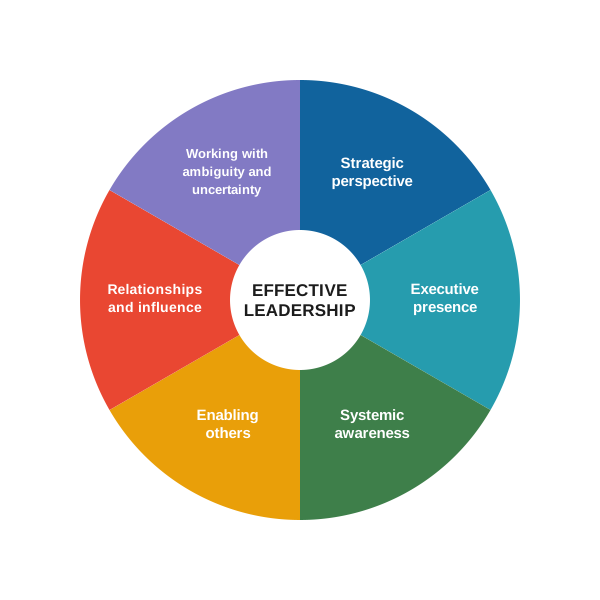
At the centre, strategic perspective becomes the organising capacity. Around it, executive presence, systemic awareness, and the ability to enable others each develop as new capacities of the same person. The expert doer identity remains, but as one part of a wider whole rather than the whole itself.
This is what the developmental psychology literature calls vertical development. Not a horizontal move from being one type of leader to being another. A growth in the capacity to hold more at once, with what you already were still held within.
What the research says
The theoretical foundation for treating identity as the substrate has been building across several converging strands of research. What follows is a synthesis of the work that most directly informs how I approach coaching senior leaders through this transition.
Scott DeRue and Susan Ashford’s leader identity construction theory, published in 2010, argues that leader and follower identities are not fixed traits but socially and relationally constructed. Someone claims a leadership identity through their behaviour and language, others grant it through their response, and repetition of that claim-grant cycle over time internalises the identity. Until it has internalised, leadership behaviours feel like performance rather than expression.
Bill Torbert and David Rooke’s work on action logics maps a related progression, from Expert (valuing one’s own technical competence) through Achiever (valuing results within the current system) to Strategist (able to question and reshape the system itself) and beyond. The move from Expert to Strategist tracks closely with what most senior leaders are being asked to do. It is not a skill acquisition. It is a developmental stage transition.
Herminia Ibarra’s research on career transitions is the most practice-oriented of the strands. Her concept of provisional selves, and her argument for outsight before insight, proposes that identity change does not come from introspection first. It comes from acting differently, often before the internal sense of self has caught up. Leaders who try to think their way into a new identity tend to stall. Those who act into it, then revise the self-concept afterwards, tend to progress.
Gianpiero Petriglieri’s work on identity and holding environments adds the emotional dimension. Identity transitions are often experienced as loss before they are experienced as growth. The leader is being asked to give up something that has served them well. Without a container that can tolerate the disorientation, most leaders retreat to the old, competent identity.
John Van Maanen and Edgar Schein’s earlier work on organisational socialisation and rites of passage frames identity transition as inherently liminal, a passage between states rather than a straight-line development. The liminal period is structurally uncomfortable. It cannot be shortened by better technique. It can only be held.
These strands are complementary rather than competing. Together they describe the shape of what actually needs to happen for a leader to move from being the person who solves the problem to being the person who builds the conditions where the answers come from everyone else.
How identity actually shifts
The research points to three actions that recur across the strands. When they happen together and repeat over time, identity moves. These actions do not sustain themselves on their own. They sit inside an environment of exploration that holds the disorientation of the change, and their repetition over months is what carries the leader through the strategic leadership shift.
Three actions cycling inside an environment of exploration. Each cycle carries the leader further along the strategic leadership shift.
The three actions form the core of what shifts identity. They are drawn from different strands of the research, and they operate together rather than in sequence.
Deliberate exposure to situations that require the new identity
Ibarra’s outsight-before-insight principle. The leader is placed, or places themselves, in contexts that require them to act at the level they are stepping into, before they feel ready. The specific expertise they have relied on is not useful in these contexts. Something else has to be tried.
Reflective processing with another mind
Kegan’s work shows that we cannot take perspective on our current way of being from inside it. The presence of another person, whose mind is not organised the same way, is what allows the leader to see the current identity as an object rather than being subject to it. This is what a good coach does, structurally, whatever their method.
Repeated cycles of claim and grant
DeRue and Ashford’s mechanism. The leader begins to act from the new identity. Others notice and respond, sometimes granting it, sometimes not. Over time, and repetition matters here, the identity is confirmed by the social environment and becomes internalised.
These three actions cycle together. Each feeds the next. But they cannot sustain themselves without two containing conditions.
An environment of exploration
Petriglieri’s contribution to the field is the concept of the holding environment, a container that tolerates the disorientation of change. I call it the environment of exploration in the work I do with leaders, because that is what it lets them do. The leader is going to be less effective at the doing while they are learning to stop doing it. The team may notice. The manager may notice. The leader themselves will feel it. Without a container that can hold the disorientation, most leaders retreat to the identity where they know they are competent.
Your leadership journey through the liminal passage
Van Maanen and Schein’s framing is that identity transition is inherently liminal, a passage between states rather than a straight-line development. The leader is not learning a skill on a curve. They are passing through a threshold. On the diagram this is labelled your leadership journey, because that is what it is for the leader passing through it. The journey has its own rhythm. There are periods of disorientation, of apparent regression, of integration that settles slowly. Naming the process as a journey rather than as failure to progress allows the leader to stay with it.
What this looks like in practice
The three actions and two containing conditions describe what has to be true for identity to shift. The practical question is how a coaching engagement creates them.
The work I do with senior leaders is structured to hold all of these, deliberately. The engagement is long enough for the journey to run its course, typically six to twelve months rather than a handful of sessions. It is spacious enough for the leader to bring what they cannot yet name to themselves elsewhere, which is Petriglieri’s environment of exploration. It is close enough that the reflective work is done together, not alone, which is Kegan’s condition. And it is grounded enough in the leader’s real work that the outsight-before-insight cycle of exposure and processing keeps happening, which is Ibarra’s.
What this means day to day is that we work with what the leader is actually facing at work. The unresolved conversation with the manager, the team meeting that didn’t go as intended, the decision that was avoided rather than made. We look together at what is happening beneath the surface of these situations. We name the identity the leader has been operating from, and the identity the situation is asking them to step into. And we notice, over months, the small ways in which the new identity begins to hold under pressure.
The leaders I work with tend to describe the process not as a series of insights but as a quiet re-arrangement of what they trust, what they are able to let go of, and what they are able to hold. The claim-and-grant cycle happens both in our conversations and in their organisation. Over time, and with the repetition that DeRue and Ashford identify, the new identity internalises.
If any of this is recognisable in the shape of what you are working with, I have written a guide that goes into what this shift involves and what makes it specifically difficult in your situation. It is tailored to what you share when you request it.
If you are a senior leader thinking about whether working with someone like me might be useful, the guide is the place to begin. If you are considering coaching for someone in your business, the same guide is where I would suggest they start.
Request the guide →